Your home shouldn't be the thing that makes you feel old.
Ageless & Independent helps you rethink the environment around your body — so you can reduce unnecessary strain, improve safety, and protect your independence for longer.
Then keep going free: the 5-day course, the interactive workbook, and the printable PDF — all free, forever.
Home Safety Self-Assessment
No. 01Rate each area 1 to 5. Higher risk gets fixed first.
*Self-reported, from William's own home. Individual results vary.
You can't stop aging. You can change the physics your body faces every day.
Most gentle aches we blame on getting older are really the environment charging the body interest. The fix isn't pushing the body harder — it's changing what the body is asked to do.
- Day to day
- 01Your bodyVision, joints, and balance are changing — but the house keeps asking the same old questions.
- 02Everyday demandsReaches, edges, steps, transitions, light — each one small, thousands a year.
- 03Pain, strain, frictionThe aches you call "just aging" are often that gap — demand the body can't cover for free.
- After the change
- 04Environmental changesSmall, specific, phased: where things live, where the light goes, where you can sit.
- 05Less unnecessary demandThe body you have faces only what it can actually handle.
- 06Greater capabilityDaily things become easier — and stay possible.
- 07Greater confidenceYou stop bracing. The stairs, the bath, the midnight walk stop being events.
- 08Longer independenceStay in the home you built, on your own terms.
Five pillars, interlocked
Aging in place fails when it's treated as one problem. It's five — and fixing one makes the others easier.
Body Intelligence
Pain as data, not destiny — decode what the body is actually reporting.
The method →Home Engineering
Your environment as a prosthetic — the room carries load your body shouldn't.
The four rules →Tech and Tools
Assistive doesn't mean ugly — lights and tools that blend into a real home.
The vocabulary →Family and Finance
The conversation that doesn't become an argument — and the paperwork behind it.
The method →Community and Crisis
Resilience over perfection — a plan for the day something actually happens.
The method →Each pillar is a full chapter in the complete guide. Read the method →
Hazards hiding in every home over 50
Every one of them is predictable. And nearly every one is fixable for less than the cost of one takeout night.
The bathroom
Slips, tub edges, low toilets. The number one room for falls after 65.
The stairs
One rail, low light, hidden edges. The transition that steals confidence.
The kitchen
High cabinets and low shelves. Thousands of micro-strains every year.
The midnight walk
To the bathroom in the dark, eyes that can't adapt, a path never lit.
The front entry
A step outside, packages on the floor, no seat to get ready.
The unplanned someday
No plan, no paperwork, no budget. Until a crisis makes the choices.
The fix that cost me zero dollars
I moved my everyday mug from the high shelf to eye level. My physio calls it the single best change I made.
The Golden Zone: anything you use weekly lives between shoulders and hips. Reach up or bend down is how most random ache is really born.
Aging is mandatory. Losing your home, your confidence, your routine: those are optional. You just have to plan before the crisis plans for you.
200+ home audits. 3 years of daily tracking. A system that genuinely worked.

The rooms where independence actually happens
Three blueprints in the guide. Here's the shape of each one.
The bathroom
Where a $40 mat ended three years of mystery hip pain.
- Slip zones and step-over edges, four tiers
- Reach and seat: handheld shower, ledge, bench
- Renter-friendly suction and clamp options
The Golden Zone rooms
Fix the reach, fix the day — thousands of micro-strains a year.
- The sitting-reach test, in one minute
- The $0 fix: the mug that moved
Where the risk hides
The risk isn't the stair — it's the transition.
- Three points of contact, always
- The $46 pathway: stair contrast, rail tape, motion light, red-and-amber night lights
- The midnight route, lit and calm
Your home has already been telling you where the problems are.
The free assessment simply lets it finish the sentence.
- 1Walk your normal daily route
From the bed, through the bathroom, around the kitchen, out the front door — the way you actually move.
- 2Identify the friction points
The reaches, edges, steps, and switches that ask more of your body than they should.
- 3Rate your key zones
A quick 1-to-5 on the rooms where risk hides. No email, no account, no jargon.
- 4Choose the single area that deserves attention first
The result hands you one starting point — not a wall of renovations. That's deliberate.
The first five days of your journey, free
Assessment, 5-day course, interactive workbook, printable PDF — free is the start. The complete guide is the system.
The 7-minute Home Safety Self-Assessment
A quick rating of the rooms where risk hides, so you fix in the right order.
The $0-$500 fix ladder for the bathroom
Cheapest, no-drill fixes first. Every rung is a real, removable upgrade.
Reorganize kitchen and living, 15 minutes
Move daily-use things into the Golden Zone between shoulders and hips.
The 3-point rule plus my $46 pathway
The lighting, seating, and surface strategy I settled on for the busiest rooms.
Track pain patterns, build a 90-day roadmap
A two-minute daily log that turns small notes into a plan you can follow.
- ✓40-point Home Safety Self-Assessment
- ✓Bathroom and Golden Zone audits
- ✓14-day Pain Pattern Tracker
- ✓30/60/90-day upgrade plan
- ✓Family conversation scripts
Free forever. Interactive in the browser, printable as a PDF.
One worksheet a day. By Friday, a plan.
The interactive workbook pairs with the five-day course: rate your home, audit the bathroom and the reach zones, track how you actually feel week to week, then lay out a 30, 60, and 90-day list of quiet upgrades.
And it includes the family conversation scripts — the exact words that turn "I'm worried about you" into a plan your parents stay in charge of.
A safer home. Less unnecessary strain.
Lasting independence.
The free plan is the map. The Complete Guide is the system — everything on this page, and the 200 home audits behind it, written down in one place a 64-year-old engineer used on his own home.
PDF + EPUB · $37 one-time · free updates for life · 30-day refund
Pages from the actual guide
Rendered directly from the print edition.
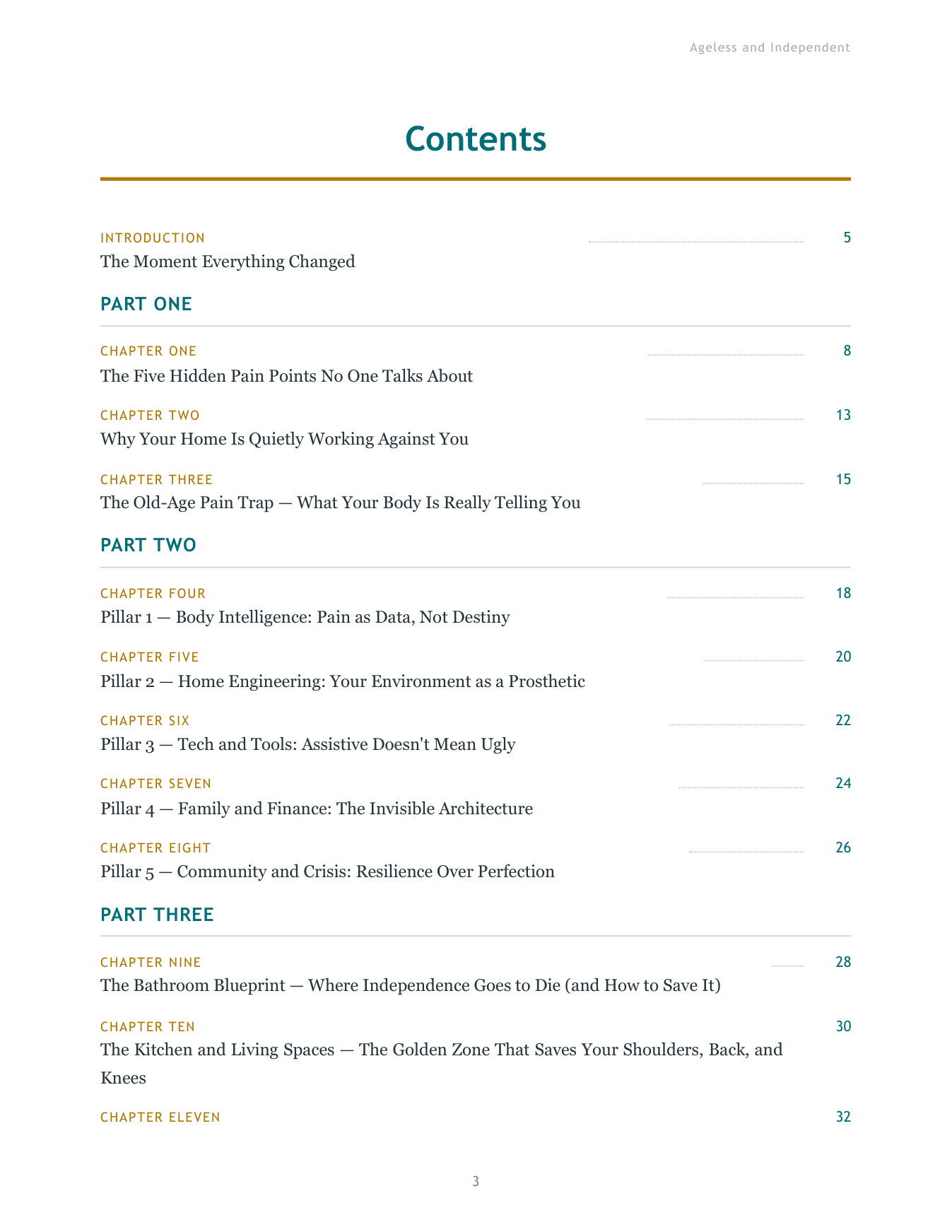
18 chapters across five parts, plus the appendix.
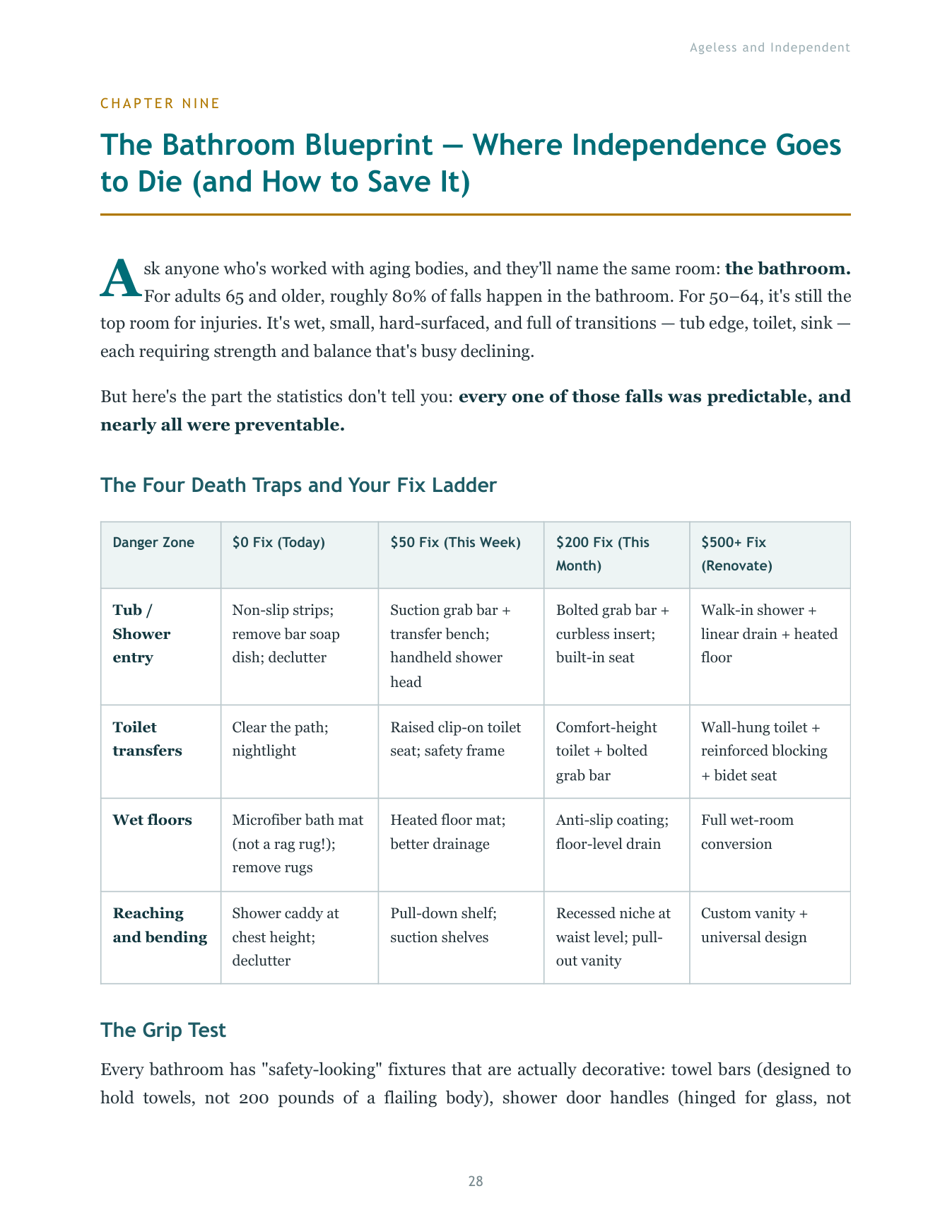
The bathroom — slip zones and the fix ladder.
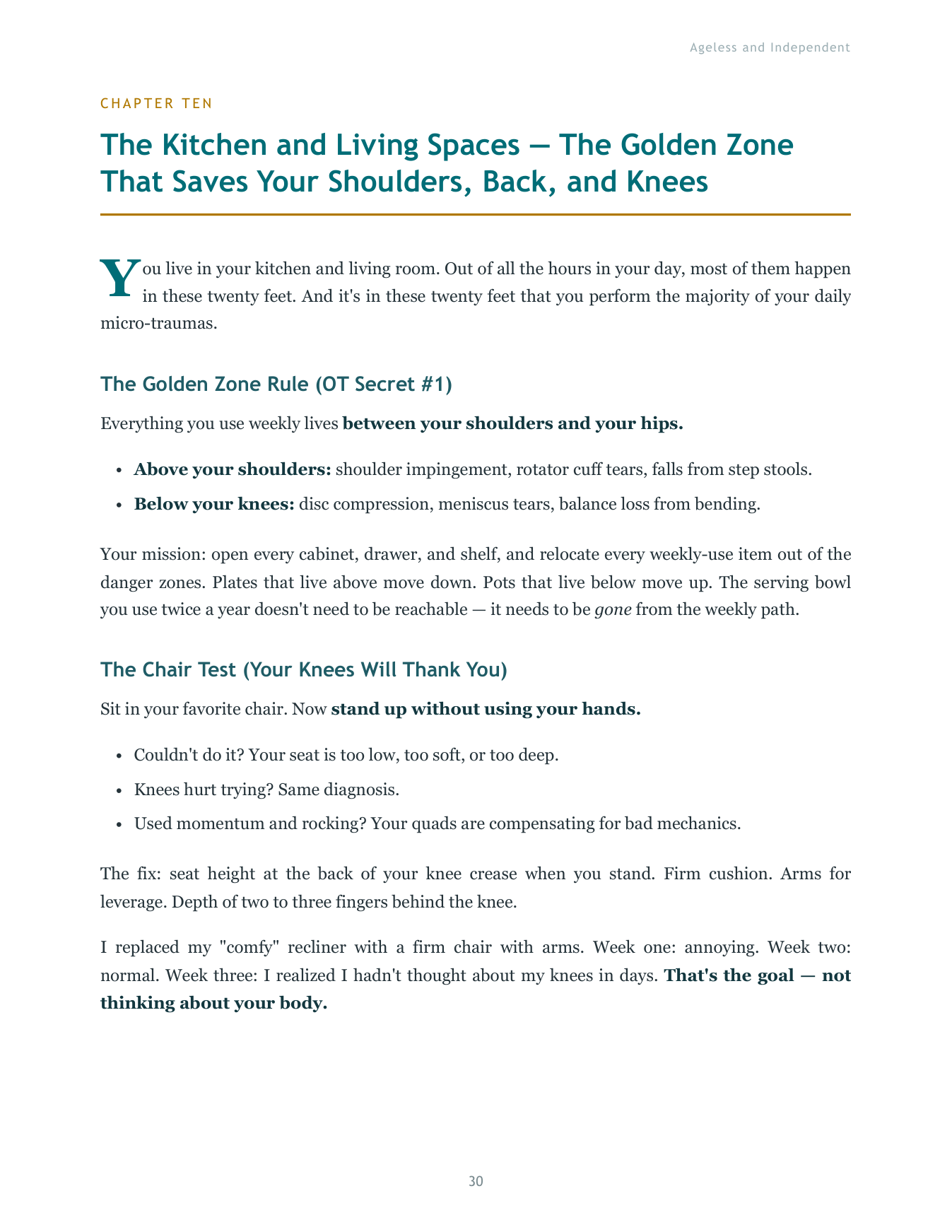
The Golden Zone applied to kitchen and living.
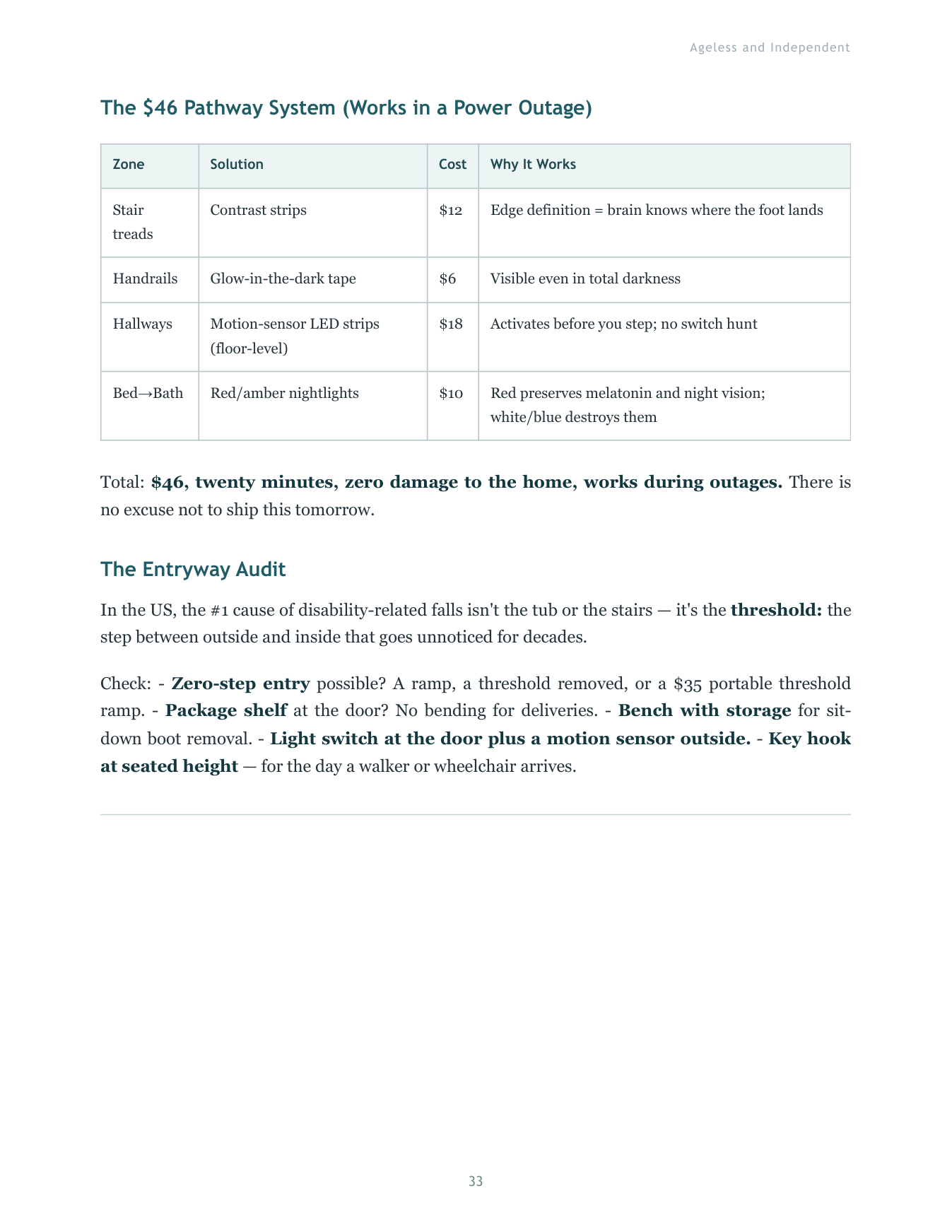
The $46 pathway — itemized, real.
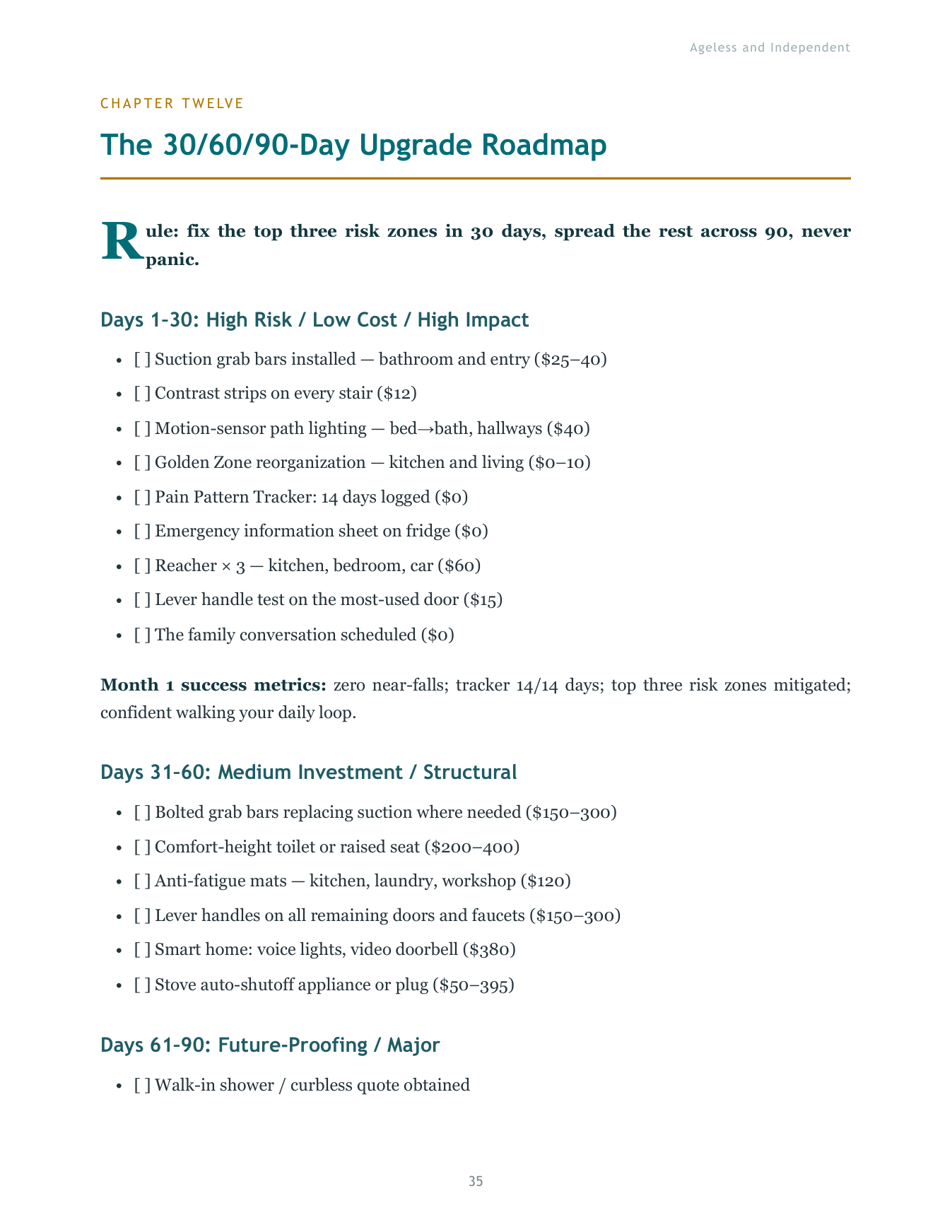
The roadmap — three honest phases.
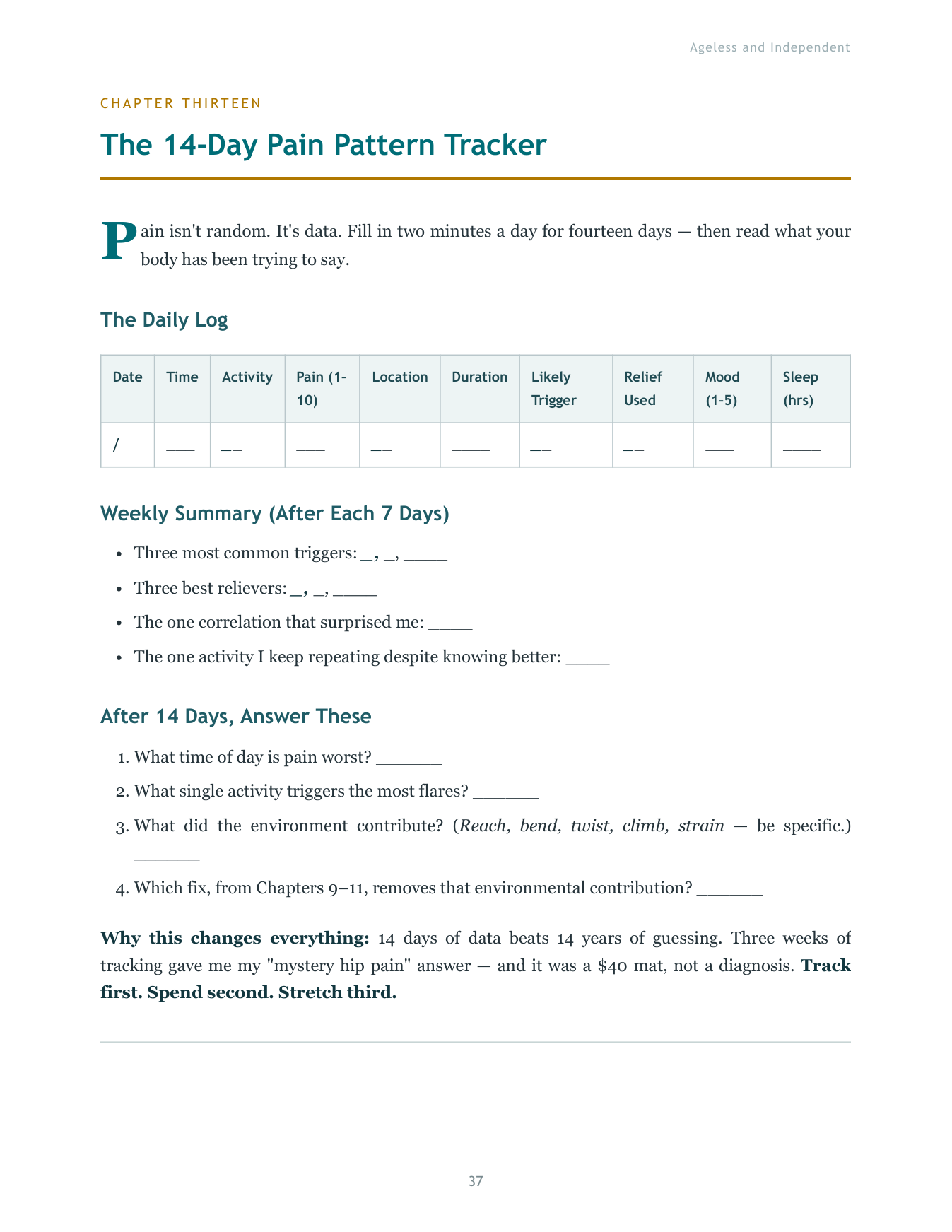
The pain tracker — data you can use.
Why five approaches keep failing
Information is everywhere. The challenge is knowing what to do first, what can wait, what it costs, and how to finish.
- ×The generic checklist
"Install grab bars. Budget $300." Ten identical lists that never mention your body, layout, or budget.
- ×The clinical assessment
Professional and intimidating, ending in a referral you can't act on this week.
- ×The contractor pitch
The estimate that turns "make it safer" into "replace the bathroom" at an unaffordable price.
- ×The adult child's panic
Concern that lands as an argument with the person it's meant to help.
- ×The academic research
Rigor that has never stood in your bathroom or priced a fix at the hardware store.
The guide exists because William read all five — and built the sixth: your environment as a prosthetic.
Four tiers. Start at zero.
Every fix in the system is laddered by price and permanence, so the work starts today — not after a renovation budget appears.
- Move weekly items into the Golden Zone
- Clear paths and landing spots
- Reposition what you already own
- Adhesives, brackets, and handles
- Battery lights for stairs and night
- No holes, renter-safe
- Grab bars and shower fixtures
- Handrails for three points of contact
- Lighting you never think about
- The step-over edge cut
- The 36-inch future-proofing
- Spaced and budgeted, done once
A 64-year-old engineer who tested it on himself
William Raphael spent 25 years designing fail-safes for aerospace and defense systems. Then his shoulder gave out on a step stool — and he applied the same discipline to his own aging: 200+ home audits, three years of daily tracking, zero falls, zero surgeries. He built the system he couldn't find online, and wrote it down so you don't start from scratch.
You are not preparing for decline. You are engineering your independence.
A grab bar isn't a medical device — it's performance equipment for the sport of staying in your own home.
Everything above, in one place
The free plan gets you started. The guide is the full system behind it.
18 chapters across five parts — the five-pillar method, room-by-room blueprints, the 30/60/90 roadmap, the 14-day pain tracker, family-conversation scripts, the tested product directory, and the quarterly reassessment.
- The complete system — 18 chapters, in order
- Room-by-room blueprints with a $0 to $500+ ladder
- Companion to the free workbook: the tools to run it
- Free updates for life — every future edition, included
One-time payment, keep the files forever. One-email refund within 30 days.
Read Part One
The five hidden pain points, one quiet evening — it gives every blueprint context.
Do one $0–$50 fix
Pick your top risk zone and complete a single cheap fix this week. Built to start small on purpose.
Get the next step
Practical ideas for making your home safer, more comfortable, and easier to live in — without turning it into a hospital. One short email, five days, free forever.
You're in.
Your first lesson is on its way. Check the promotions or spam folder if it takes a few minutes.
Some notes people have left on my fridge
Mom refused grab bars for five years. Showing her the "performance equipment" note changed her mind in twenty minutes.
Daughter and caregiver, near Indianapolis
A short note, taped to the fridge.
Fair questions
Is this really free?
Yes. The 7-minute assessment, 5-day course, and workbook are $0 forever. The Complete Guide is a paid product — but roughly 80% of the value of the whole system should live in what you do for free.
Is this a medical book?
No. Everything here is educational, not medical advice. It helps you spot friction your body is dealing with and tells you exactly when to hand a problem to a doctor, PT, or occupational therapist.
I rent. Will this work for me?
Mostly, yes. About 80% of the 30-day plan uses suction bars, command strips, battery lights, and removable fixes: zero holes, zero deposit risk. The guide calls out renter options at every step.
Do I need to renovate my home?
No — and the system is designed so you never have to renovate your way to safety. Everything laddered from $0 to $500+, and most of the value lives in the $0–$200 range.
I'm only 51. Isn't this premature?
This is exactly the decade for it. Prevention costs a tenth of a crisis, bodies still adapt, and a two-minute pain log can catch trouble three to five years early.
My parents won't listen to me.
That's the point of the framework. Share the 7-minute assessment, let the data have the conversation, then use the scripts so they stay in charge.
How much time does it take?
Five days times 15 minutes of reading, plus one workbook page a day. Most people tell me week one is the only week that takes effort.
What's the difference between the free workbook and the guide?
The free workbook is the map and the audit tools. The Complete Guide is the system behind them: 18 chapters, the five-pillar method, room-by-room blueprints, and the resource directories. Workbook is the floor; the guide is the house.
What format is the guide, and what if it's not for me?
PDF + EPUB, $37 one-time, free updates for life, and a one-email refund within 30 days — you keep the files either way.
Aging is mandatory.Losing your home is optional.
Seven minutes from now, you'll know your starting point. Start free — or go straight to the complete system.